Create in the NOW · Article
The Laws of Futurism
Why We Keep Getting the Future Wrong
The Laws of Futurism are a set of enduring observations, drawn from futurist Roy Amara, computing pioneer J.C.R. Licklider, and author Arthur C. Clarke, that explain why predictions about technology so often miss: we overestimate short-term change, underestimate long-term transformation, and underestimate what ultimately becomes possible.
Predicting the future has always been one of humanity's favorite pastimes, and one of its greatest challenges. From flying cars to artificial intelligence, people have a remarkable tendency to misunderstand how change unfolds. Some technologies seem overhyped and disappointing at first, only to become world-changing decades later. Others appear impossible until they suddenly become commonplace.
Three principles, formulated across three different decades by three very different minds, help explain this pattern.
Amara's Law: The Long-Term Impact Is Usually Bigger Than We Think
Futurist Roy Amara, former president of the Institute for the Future, is credited with one of the most quoted observations about technological change:
“We tend to overestimate the effect of a technology in the short run and underestimate the effect in the long run.”
Roy Amara, Institute for the Future
When a new technology appears, expectations often soar. Investors, media, and early adopters imagine immediate transformation. Reality rarely cooperates. Adoption takes longer, infrastructure develops more slowly, and human behavior changes gradually.
Yet over time, the opposite problem emerges. Once the initial excitement fades, people often fail to appreciate how profoundly a technology can reshape society over decades.
The internet provides a classic example. Early predictions in the 1990s often exaggerated what would happen within a few years, yet few foresaw how deeply digital networks would transform communication, commerce, entertainment, education, and daily life.
Licklider's Law: The Timeline Trap
Computer pioneer J.C.R. Licklider expressed a similar idea in Libraries of the Future (1965):
“People tend to overestimate what can be done in one year and to underestimate what can be done in five or ten years.”
J.C.R. Licklider, Libraries of the Future, 1965
Many thinkers have echoed the principle since, including Bill Gates in The Road Ahead.
Licklider's insight highlights a common cognitive bias: people think linearly while technological progress often compounds. Early advances may seem modest, but cumulative improvements can eventually create outcomes that appear revolutionary.
This explains why many innovations seem to arrive all at once when, in reality, they have been developing quietly for years. Licklider knew this firsthand. His influence reached far beyond forecasting: his early vision of networked computing helped shape the internet itself, decades before most people saw it coming.
Clarke's First Law: Beware the Limits of Expert Certainty
Science fiction author and futurist Arthur C. Clarke offered another important lesson, first published in his 1962 collection Profiles of the Future:
“When a distinguished but elderly scientist states that something is possible, he is almost certainly right. When he states that something is impossible, he is very probably wrong.”
Arthur C. Clarke, Profiles of the Future, 1962
History is filled with declarations that certain breakthroughs would never happen:
- Humans would never fly.
- Computers would never become personal.
- Machines would never understand language.
- Artificial intelligence would remain forever limited.
Again and again, reality has proven more inventive than expert consensus.
Clarke's law is not a rejection of expertise. Rather, it reminds us that the boundaries of possibility are often wider than current knowledge suggests.
The Common Thread
Together, these three principles reveal a recurring pattern:
The Short Run
We overestimate short-term change. New technology rarely transforms the world on the schedule its enthusiasts announce.
The Long Run
We underestimate long-term transformation. Compounding progress reshapes society more deeply than early forecasts imagine.
The Possible
We underestimate what may ultimately become possible. The boundaries of the achievable keep moving past expert certainty.
The future rarely arrives on schedule, but it often arrives with greater force than expected.
Creating the Future Instead of Predicting It
An important implication of these laws is that the future is not only something to forecast. It is something to help create. A line often attributed to management thinker Peter Drucker puts it plainly: the best way to predict the future is to create it.
This idea is the heart of Create in the NOW by Sherrie Rose. Rather than focusing solely on prediction, the book emphasizes the power of present action, conscious choice, and creative engagement with emerging possibilities. The long run that Amara and Licklider say we undervalue is exactly what the vision layer of enhavim addresses: vision leading purpose and mission, so that decades-long possibility shapes what you build today. Momentum follows once mission puts purpose into action.
The lessons of Amara, Licklider, and Clarke suggest that while forecasts are useful, the greatest opportunities often belong to those who remain adaptable, continue learning, and participate in shaping what comes next.
What the Laws Teach
The Laws of Futurism offer a valuable reminder of both humility and optimism. The future is rarely as immediate as enthusiasts hope, yet often far more transformative than skeptics imagine. Technologies evolve, societies adapt, and possibilities expand beyond current assumptions.
If history teaches anything, it is this: the future is usually larger, stranger, and more consequential than we expect. The people best prepared for it are those willing to keep learning, experimenting, and creating in the present moment.
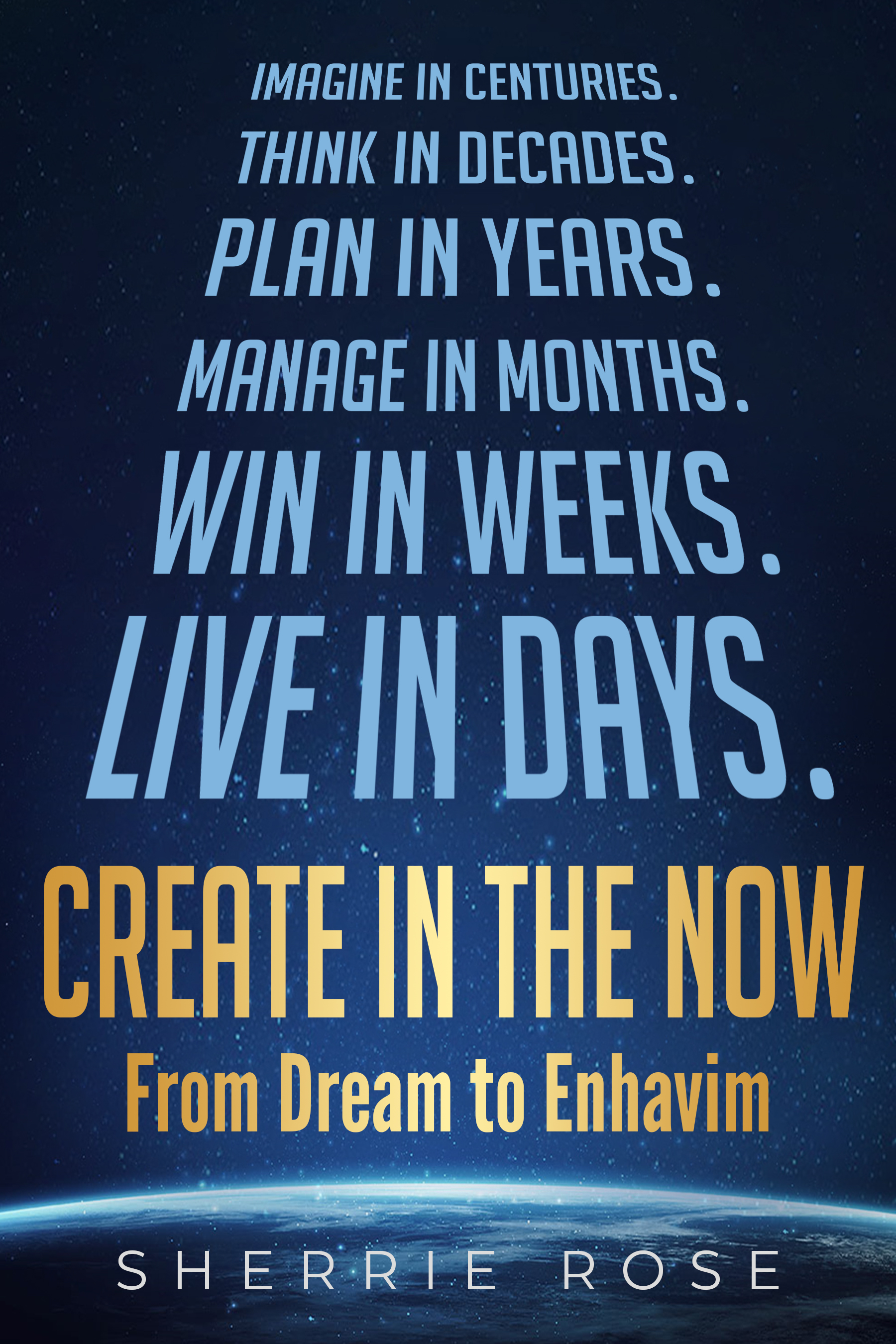
Create in the NOW
The futurists got one thing consistently right: the long run rewards those who act in the present. Create in the NOW: From Dream to Enhavim shows how to hold a long-horizon vision while creating with what is in front of you today.
In a world where technological and social change keep accelerating, the ability to act intentionally now may matter more than the ability to predict tomorrow with precision.